


France → USA: The hidden tax trap of your dividends
Updated: Jun 22

Moving to the United States without closing their French company has become a strategic reflex for many French entrepreneurs. Miami for its tax advantages and international ecosystem. Austin for its tech sector. New York for access to financial markets...
The structure remains in France — for historical, legal or operational reasons — while the personal residence shifts across the Atlantic.
From a business perspective, the equation seems coherent. However, from a tax perspective, it changes profoundly.
Because as soon as you become a US tax resident, your French dividends cease to be a simple domestic flow. They become international income subject to three levels of analysis:
taxation in France,
the withholding tax governed by the tax treaty,
US federal taxation, and possibly additional taxation.
Taxation is not simply accumulated, it is reconfigured.
The first step: taxation in France
In France, the profit of a company subject to corporation tax is taxed at the normal rate of 25% (Article 219 of the General Tax Code – impots.gouv.fr ).
Dividend distribution therefore occurs after initial taxation. This fact is generally factored into the calculations. It is not the main point of contention.
Withholding tax as governed by the France-USA convention
The tax treaty between France and the United States (Article 10) provides for a cap on withholding tax:
15% withholding tax in principle
5% when the beneficiary is a company holding at least 10% of the capital
0% in certain specific cases, particularly for certain qualifying pension funds
( Source: France-USA Tax Convention – irs.gov )
The convention organizes the allocation of the right to tax. However, it does not abolish taxation.


American taxation
The United States taxes its residents on their worldwide income ( Internal Revenue Service – irs.gov ).
Dividends received from a foreign company may, under certain conditions, be classified as “qualified dividends” and benefit from the preferential rates applicable to long-term capital gains, namely 0%, 15% or 20% depending on the level of income ( IRS – Topic No. 409 ).
Some taxpayers may also be subject to the Net Investment Income Tax (NIIT) of 3.8% , beyond certain income thresholds ( IRS – NIIT Guidance ).
A foreign tax credit mechanism allows, under specific technical conditions, for the offsetting of French tax against US federal tax owed. However, the effectiveness of this mechanism depends on the taxpayer's overall situation and the rules applicable to different income categories.
In other words: the flow is regulated, but never neutral!
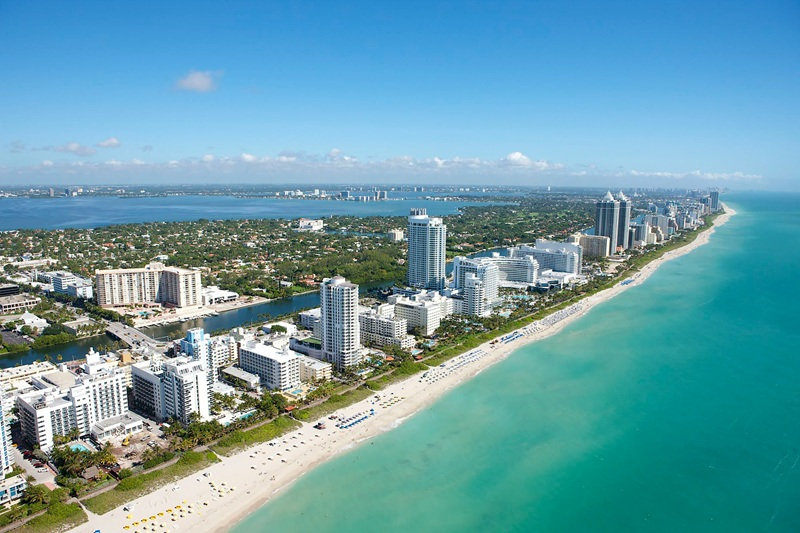
The special case of Miami: the illusion of “no state tax”
Miami holds a particular appeal for French entrepreneurs. Florida does not levy state income tax. The environment is international and business-friendly.
But the absence of state tax does not mean the absence of taxation.
French dividends received by a Florida resident remain fully subject to US federal taxation. They may, under certain conditions, benefit from the rates applicable to qualified dividends and be subject to the 3.8% NIIT (National Income Tax Rate).
But be warned: Moving to Florida eliminates a local layer. It doesn't transform an international flow into neutral income.
Substance and residence
A company incorporated in France remains, in principle, a French resident.
However, in the event of potential dual residence, the tax convention (article 4) provides for rules of differentiation based in particular on the place of effective management.
When strategic and operational management is exercised from the United States, this dimension deserves specific analysis.
This is no longer a mere administrative detail. It is, on the contrary, a matter of international architecture.
🇺🇸 United States vs 🇨🇦 Canada: A useful comparisonIn Canada, the absence of a mechanism equivalent to the dividend tax credit for foreign dividends can significantly impact the effective rate. In the United States, preferential rates applicable to qualified dividends may seem attractive, but the potential addition of NIIT and the mechanics of foreign tax credits complicate the analysis. In both cases, the central question remains the same: what is your actual consolidated rate after changing residence? 👉 Are you based in Canada? Check out our dedicated analysis: |

The Blendy approach
International taxation is never simply a matter of a single tax rate.
Between France and the United States, it is not withholding tax that determines the relevance of a strategy. It is the coherence of the structure, the actual location of the decision, the nature of the flows, and the alignment between personal residence and legal organization.
Maintaining a French company while becoming a US resident can be perfectly viable, provided that compensation, governance, and economic substance are designed with a transatlantic perspective.
The question is not “how much do I pay?” The question is: does my structure reflect my international reality?
At Blendy, we support executives between France and the United States with a consolidated approach, based on conventional analysis, modeling of the true effective rate and securing the substance.
In international taxation, performance comes from structuring — never from improvisation.
You live in the United States and
do receive dividends from a company based in France?
The correct approach is to calculate your actual consolidated effective rate.
Official sources
Corporate tax – France: https://www.impots.gouv.fr
France-USA Tax Treaty: https://www.irs.gov/pub/irs-trty/france.pdf
IRS Topic No. 409 – Qualified Dividends: https://www.irs.gov/taxtopics/tc409
Net Investment Income Tax – IRS: https://www.irs.gov/newsroom/questions-and-answers-on-the-net-investment-income-tax
Foreign Tax Credit – IRS: https://www.irs.gov
With Blendy , international CPA based in France, Canada and the USA, take advantage of digital accounting and tailor-made advice to accelerate your financial process and develop your business.
Pennylane, Dext, QuickBooks and Stripe certified, we support digital and IT companies, e-Commerce, SaaS in France and internationally.


