


Your company earns $100,000: how much cash can you withdraw in France vs in Florida?

Your business is making money and profits. Congratulations! You're on the right track. But do you really know how much of that profit can actually end up in your personal account?
This is where the tax comparison between France and Florida becomes interesting. Because the corporate tax rate only tells part of the story.
For a shareholder-manager , it is essential to first consider the entire journey of the cash: company profit, corporate tax, and then taxation at the time the money is paid to the manager.
And in this respect, France and Florida operate very differently.
This article presents deliberately simplified scenarios to illustrate the differences in tax mechanisms between France and Florida. Applicable taxation depends in particular on the legal structure, the tax residency of shareholders, tax treaties, and the nature of the income.
For more information, ask Blendy, an international chartered accountant .
In France, withdrawing profits from a SAS (simplified joint-stock company) is done in two stages.
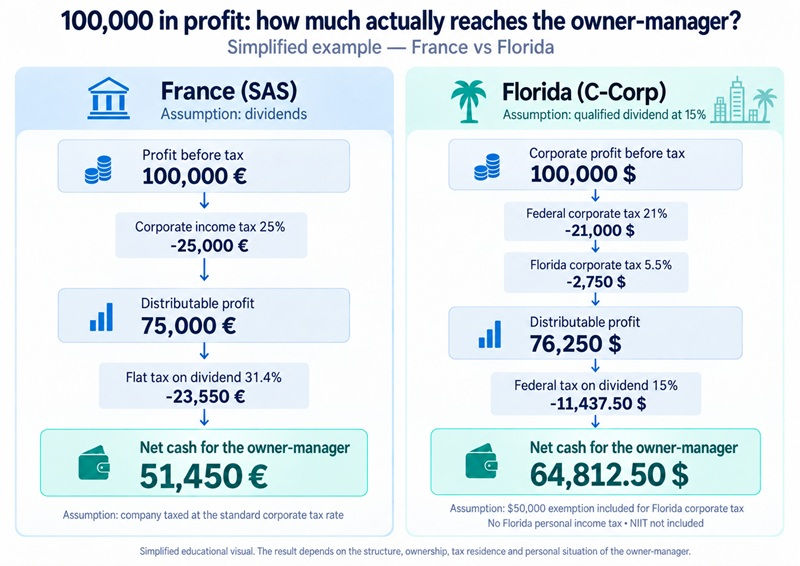
Let us take the example of a French SAS which makes €100,000 of profit before corporate tax (IS - impôt sur la société) , and whose shareholder then wishes to recover the balance in the form of dividends.
First step: corporate tax
The standard corporate income tax rate in France is 25%. Some SMEs may be eligible for a reduced rate of 15% on the first €42,500 of profit (subject to conditions).
To keep things simple, let's first consider a French company taxed entirely at 25%.
Of the €100,000 profit, €25,000 is subject to corporate income tax. This leaves €75,000 that can be distributed. But those €75,000 are not yet in the manager's pocket.
The dividends are then taxed at the shareholder's expense.
Since January 1, 2026, the flat tax rate (PFU - prélèvement forfaitaire unique) on capital income has increased to 31.4%: 12.8% income tax and 18.6% social security contributions. The French social security agency (Urssaf) also confirms this rate for dividends from SAS or SASU companies.

Let's return to our SAS example. Of the €75,000 distributed, €23,550 is therefore deducted as a flat-rate tax. The CEO is left with €51,450 net out of the €100,000 initially generated by the company.
In other words, in this simplified scenario, almost half of the initial profit is absorbed between corporate income tax and dividend taxation.
The situation can be slightly more favorable when an SME benefits from the reduced corporate tax rate of 15% on its first €42,500 of profit. But the principle remains the same. Before reaching the shareholder, the profit goes through two levels of taxation.
€100,000 in profit therefore does not mean €100,000 available personally.
And that's precisely where the comparison with Florida becomes interesting.
In Florida, C-Corps also face double taxation
Contrary to a common misconception held by most French entrepreneurs, creating a company in the United States does not automatically eliminate double taxation.
First tax in the US: the corporate income tax
A C-Corporation is fiscally separate from its shareholder. It first pays tax on its profits. The federal corporate income tax rate is 21%.
In Florida, a 5.5% corporate income tax may be added, calculated according to state rules. A $50,000 exemption applies, in particular, when calculating the Florida corporate income tax.
But it would be wrong to simply add 21% and 5.5% and announce a uniform rate of 26.5%.
Dividends are also taxed at the shareholder level.
When a C-Corp distributes its profits to its shareholder, a second level of taxation may also apply, just as in France.
The Internal Revenue Service (IRS), the American federal tax administration, states it very clearly: the profit of a C-Corp is taxed first at the company level, then again at the shareholder level when it is distributed as a dividend.
Based on this principle, the mechanism is similar to that observed in France. However, the rates and rules applicable to shareholders are different.

Florida's major tax advantage also lies with the shareholder.
In the United States, qualified dividends may be subject to a federal tax rate of 0%, 15%, or 20%, depending on the taxpayer's tax situation. An additional Net Investment Income Tax of 3.8% may also apply above certain income thresholds.
But Florida has one key characteristic: it does not apply personal income tax.
A Florida resident obviously remains subject to US federal tax, but no additional personal tax from the State of Florida is added.
This is one of the major differences with France when analyzing what the owner actually retains once the cash is withdrawn, and not just the company's taxation.
And with an S-Corp, the comparison changes again.
This is where simply comparing "French company versus American company" becomes misleading. An American company can opt for the S-Corporation regime, when it meets the necessary conditions.

Under this system, profits are generally paid directly to shareholders and taxed on their personal tax returns. This helps avoid the double taxation typically associated with C-Corps.
But there is an important downside for the manager who works in the company.
He cannot simply convert all of his compensation into distributions to avoid US social security contributions.
The IRS requires executive-shareholders working for their S-Corp to receive reasonable compensation, meaning a salary commensurate with the work actually performed. This salary is then subject to payroll taxes. The remaining amount can then, under certain conditions, be distributed differently.
This is one of the reasons why the shareholding structure becomes crucial.
And for a French entrepreneur, there is another major limitation: a non-resident alien cannot be a shareholder of an S-Corporation.
The relevant structure therefore depends as much on the tax residence and status of the shareholder as on where the company is created.

"How much cash will I get?" is ultimately not the right question.
To compare two tax environments, looking only at corporate tax gives an incomplete view.
For an entrepreneur who is also a shareholder, the true simulation should follow the cash flow all the way to the end: How much the company earns → how much it pays → how much it distributes → how much the manager actually keeps.
In France as in the United States, the result then depends on the status of the company, the method of remuneration of the manager, his tax residence and his personal situation.
And when a French executive plans to develop a business in the United States, the question becomes even more important: the American company that is least taxed on paper is not necessarily the one that will allow its shareholder to recover the cash under the best conditions.
Therefore, the entire structure — company, compensation and shareholding — must be checked and defined before making a choice.
Blendy helps you structure cash outflow, not just the company
At Blendy, we support leaders who are developing their business between France and the United States, with teams present in both countries.
The goal is not simply to choose between a SAS, a C-Corp, or another structure. We look at the entire scheme: where the business is located, where the manager resides, how they are compensated, how profits are distributed, and how the shareholding is structured.
This overall view makes it possible to simulate what each option really implies, from both the company's and the manager's perspective, before putting the structure in place.
Are you planning to establish a presence in the United States or do you already have a company on both sides of the Atlantic?
Blendy can help you model different scenarios and choose an organization that aligns with your objectives.
This article presents deliberately simplified scenarios to illustrate the differences in tax mechanisms between France and Florida. Applicable taxation depends in particular on the legal structure, the tax residency of shareholders, tax treaties, and the nature of the income. For more information, contact Blendy, an international chartered accountant.
Sources:
With Blendy, English-speaking French CPA based in Paris, Montréal and Miami, take advantage of digital accounting to accelerate your finance process and develop your business.
Pennylane, Dext, QuickBooks and Stripe experts, we support digital and IT service companies, e-Commerce, SaaS, SMBs, in France and internationally.


